The ocean has rights
09/01/2024
The Seal Research Trust (SRT) understands that the ocean has rights, so our charity has always aimed to give seals and the sea a voice. 2023, saw SRT’s focus on marine conservation well and truly spotlighted on the global stage.
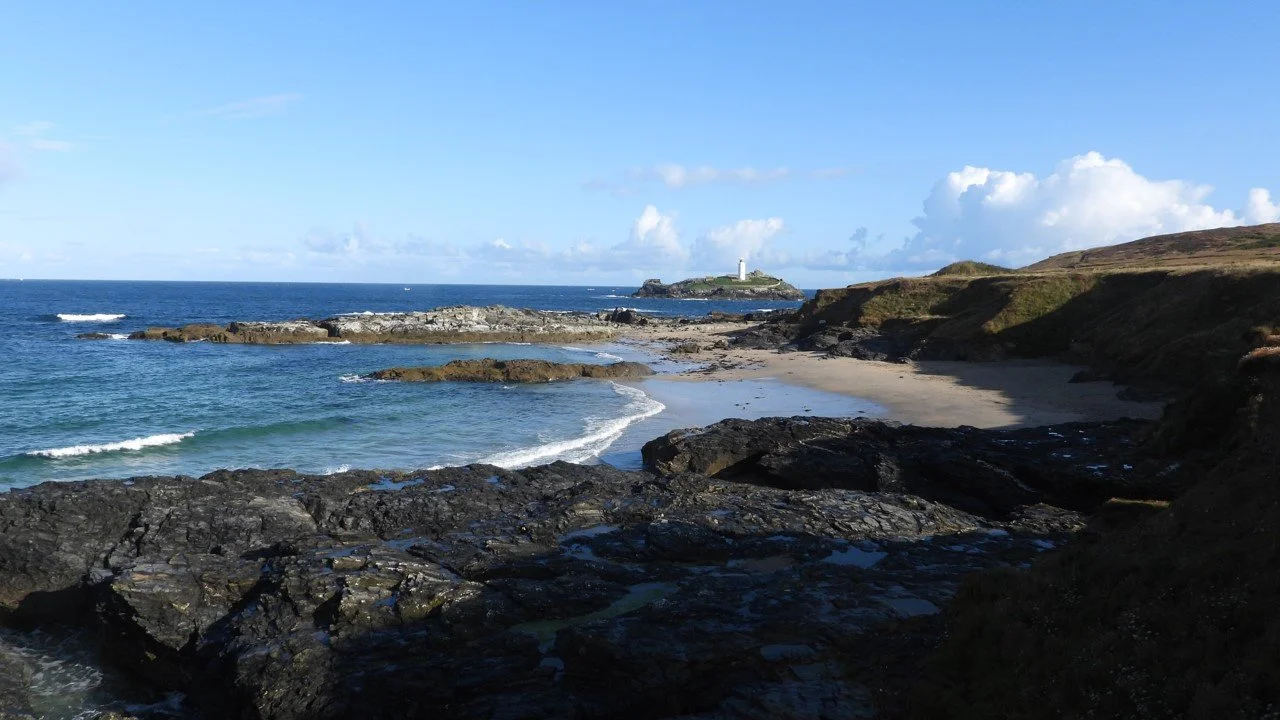
St Ives Bay with its iconic lighthouse that inspired Virginia Woolf book ‘To the Lighthouse’
Geoengineering project proposal for St Ives Bay
On 19/01/23, SRT were present at a routine Cornwall Marine Liaison Group meeting where a Canadian startup company Planetary Technologies (PT) presented their plans for a Carbon Dioxide Removal (CDR) Ocean Alkalinity Enhancement (OAE) geoengineering project that would see tonnes of Magnesium Hydroxide (MH) released into St Ives Bay. SRT later learned that an initial trial took place in September 2022 that local communities and the public were not informed about.
By March, PT had held two small public meetings in Hayle and Truro. SRT hosted two face to face meetings with PT’s CEO Mike Kelland and PR Lead Pete Chagrin, where SRT’s Steering Group were able to pose their questions about PT’s plans.
The St Ives Bay community is very willing and able to engage, understand, scrutinise and hopefully pass on learning to other communities facing similar issues. Local communities here are extremely protective of their marine ecosystems that support health and wellbeing, as well as vital financial economies where tourism, based on a quality marine environment, is key. Additionally, Cornwall is blessed with a network of over 20 existing local marine conservation groups, all focused on protecting our vital coastal environmental assets in partnership with numerous NGOs such as SRT supported by excellent marine focused Universities.
Science concerns
SRT began exploring relevant science and research. One paper showed that when used as a purifier in a closed system, ‘MH can create nanoscale solid wastes containing a high concentration of pollutants that are harmful to the environment’ (Lui et al 2020). Hartmann et al 2023 stated that ‘the real world application of OAE remains unclear as its most basic assumptions are untested. Before large scale deployment can be considered, safe and sustainable procedures for the addition of alkalinity to seawater must be identified and governance established. The potential impacts of adding alkaline materials on marine organisms and ecosystems is still largely unknown. Overall the side effects of OAE on organisations and more importantly on ecosystems, is largely unknown and deserves research at the experimental level, to provide better knowledge in order to make informed decisions on whether or not alkalinity enhancement is a feasible mitigation strategy’.
Environment Agency and Water Research Centre
As a result SRT began writing to the Environment Agency (EA) outlining our thoughts and posing questions we did not know the answers to. To date we have submitted four letters to the EA. We were delighted when the EA contracted the Water Research Centre (WRc) to conduct an independent audit of PT’s project license application. As a result, after several online contacts with the WRc, we submitted a letter outlining our monitoring expectations and provided detailed data about seal habitat use in St Ives Bay. We also summarised the available scientific information (albeit limited) about seal senses, suggesting their likely abilities to detect changes in water chemistry and the marine environment.
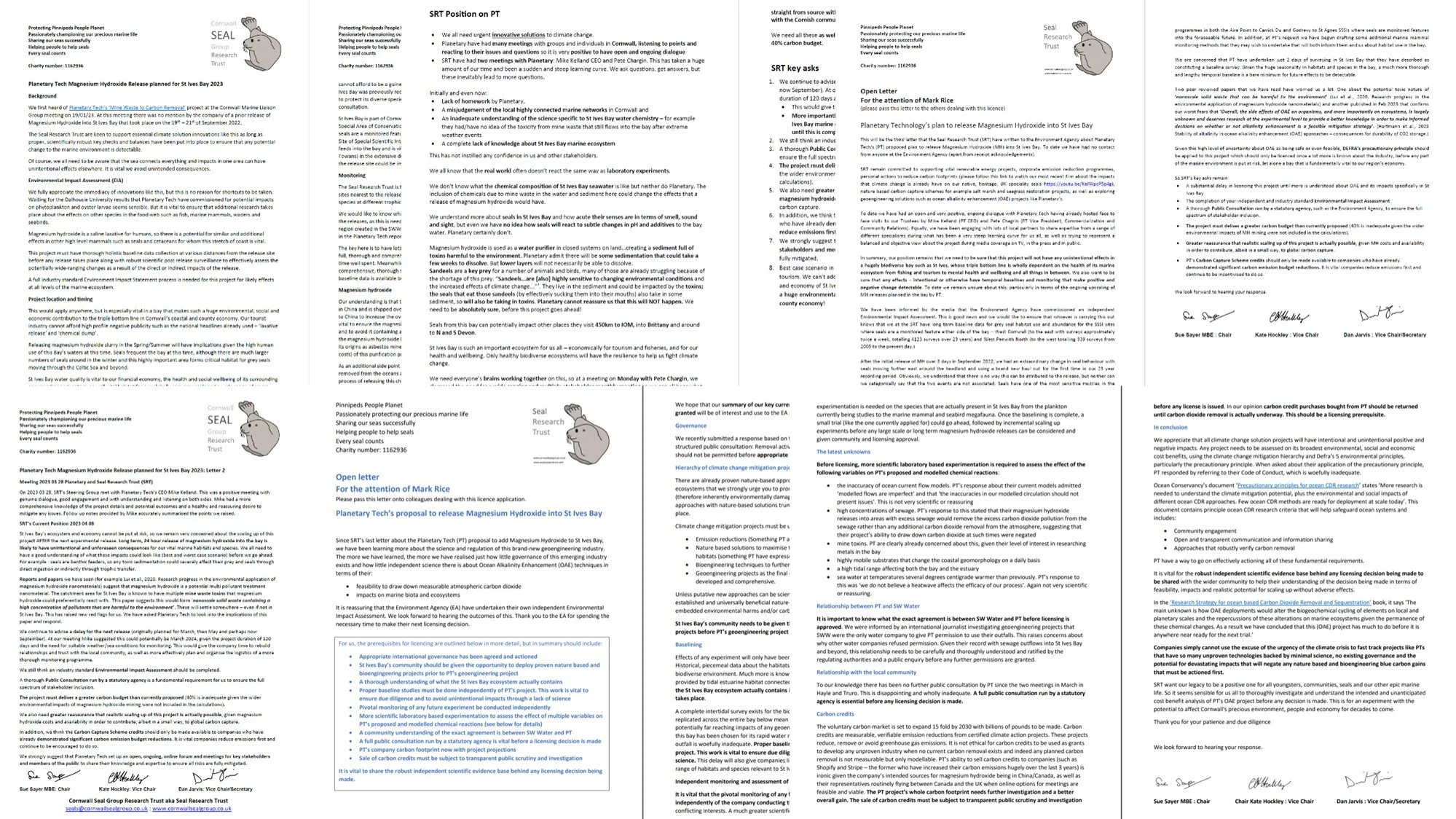
Some of the letters written to the statutory agencies
South West Water
Given PT had already, and planned to again use South West Water’s (SWW) infrastructure, SRT engaged directly with SWW to share our growing concerns about the unknown status of impacts of PT’s project on marine ecosystems and to best help SWW conduct their effective due diligence duties on behalf of their shareholders and the SWW community. SWW’s CEO requested a meeting with SRT which was held on 29/11/23. Present at the online meeting were John Halsall (Pennon’s Chief Operating Officer) and two of his colleagues (Rebecca Bragg and Guy Doble), as well as SRT’s Director Sue Sayer MBE and Science Advisors Dr Ian Hendy (blue carbon and habitat restoration expert) and David Santillo (Greenpeace International’s geoengineering expert). A second meeting was held between SRT and SWW in early February 2024 and a third one planned. At these meetings SRT aim to help SWW to consider a wide range of issues associated with PT’s planned experiment to help their board make informed decisions.
National Interest
The project quickly gained national interest. Throughout 2023, SRT received numerous requests to participate in articles about PT’s CDR OAE project and articles appeared in the Times and Sue Sayer made numerous appearances on the BBC news, as well as being a panelist on the Politics Show SW in October 2023 https://drive.google.com/file/d/1UigC_mlZSQuV0TXpCaErElCGywyVLoLN/view?usp=sharing
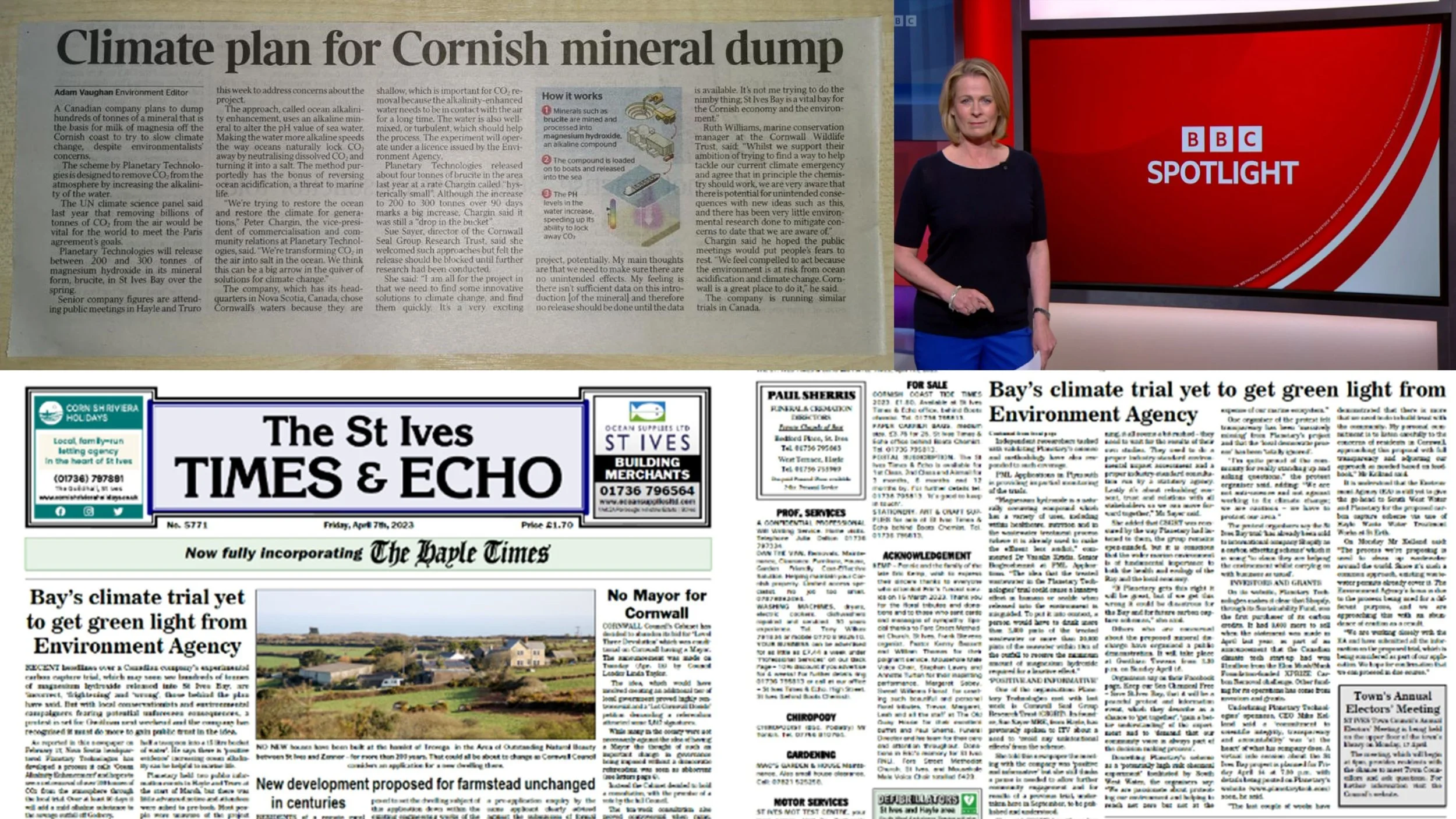
National and local media coverage examples
Global Interest
Turns out the proliferation of marine geoengineering projects are also a global concern. Several international journalists have interviewed SRT about this geoengineering project including ones from Canada, where PT’s activities seem to have been given the green light with minimal community publicity or involvement.
SRT were also contacted by ‘Hands Off Mother Earth (HOME) an international NGO and the Centre of International Environmental Law (CIEL). These organisations encouraged us to share our case study experiences with the United Nations, as part of their ‘Removal Activities under article 6.4 Mechanism’ consultation, which we did. SRT gratefully received a lot of invaluable support, advice, science and contacts from HOME and CIEL and were happy to reciprocate by accepting their invite to present the PT geoengineering case study at a webinar in October. HOME and CIEL are both keen to put more capacity towards supporting civil organisations such as ourselves to upskill and empower more communities, to better understand the global and legislative context of geoengineering projects on their patch.
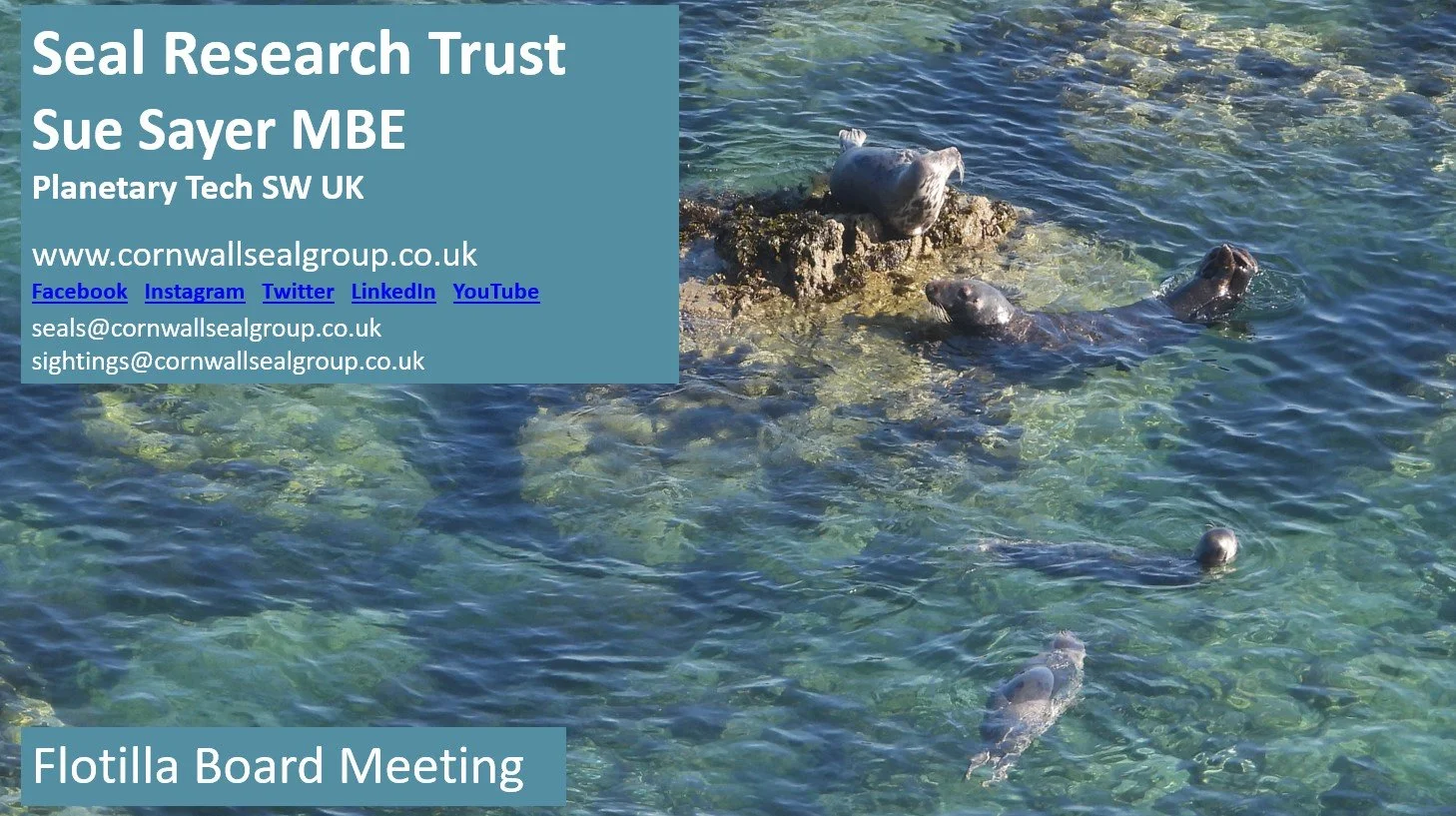
SRT’s presentation to Flotilla
Flotilla Foundation
In November SRT were invited to participate in a presentation to board members of the Flotilla Foundation, a charitable organisation based in the Netherlands focused on the marine environment.
A few days after the board meeting, the Flotilla Foundation contacted SRT’s Sue Sayer MBE to say, to our utter amazement, they were offering SRT £25,000. This money could be used to core fund SRT, given the huge amount of time and effort spent by SRT to ensure the marine environment of St Ives Bay and its globally rare seals had a voice in this geoengineering project. SRT are keen to ensure our local community now have resources to support any actions needed to face the short, medium and long term implications, monitoring and impacts of PT’s CDR OAE geoengineering project in Cornwall. Funds could also be used to kick start a Nature Based Blue Carbon Plan for St Ives Bay, as an effective alternative way to increase the sea’s pH, with multiple biodiversity, community and economic benefits to local communities.
The ocean has rights and needs our voice!
We are sharing this story to be transparent and explicit about the origins of this funding, which was not imagined, requested or expected by SRT. It was offered by the Flotilla Foundation, inspired by the amazing actions of SRT’s volunteers, our wonderful partners in the Cornwall Carbon Scrutiny Group and local community members, whose only aim is to ensure that St Ives Bay’s marine ecosystem is fully protected and becomes more vibrant and biodiverse in the future. We all need to protect our ocean, which has rights and needs our voice to enable future generations of seals and people to thrive!
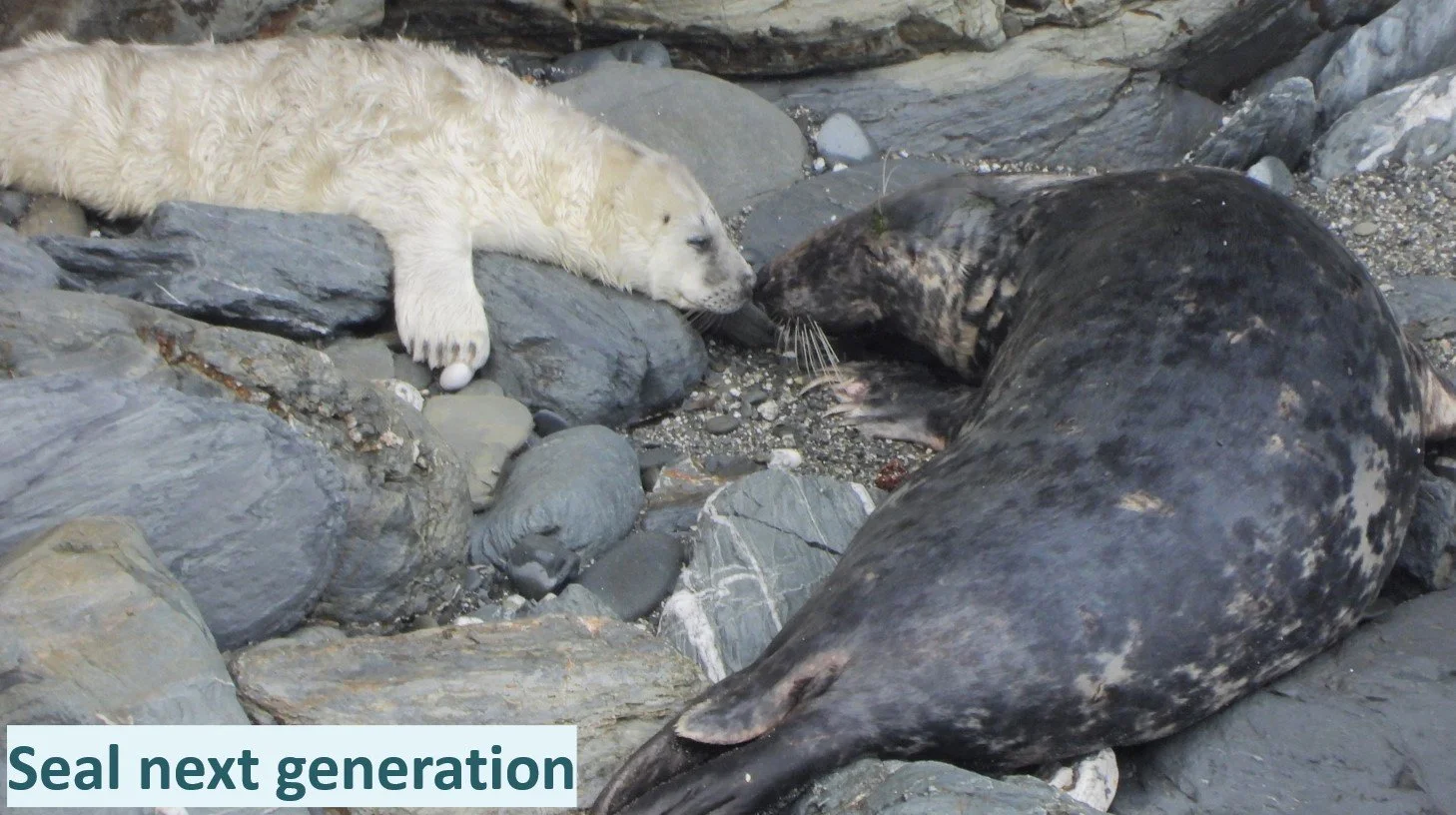
SRT aims to protect the marine environment for future generations of seals and people
Open dialogue with Planetary Technologies
SRT remain in open dialogue with PT and on 15/03/24 PT presented their 2 day ‘Baseline’ results from May 2023 to the Cornwall Carbon Scrutiny Group (CCSG). 8 staff from PT were present along with 14 CCSG members. PT’s chief scientist agreed with CCSG that:
The May data was not a comprehensive spatial or temporal survey
This survey did not constitute a baseline
PT’s preferred static species (bivalves) were not present for surveying at the diffuser site
The control site had multiple parameters that varied from the diffuser site, so is not ideal or comparable, nor therefore suitable, as a control site
Highly responsive communication systems are required by SWW and PT to avoid dosing during storm outflow events.
PT’s CEO Mike Kelland also confirmed that Carbon Credits are part of PT’s business model, albeit not being sold to support the St Ives Bay experiment. SRT consider PT’s scientific research should not be allowed due a commercial conflict of interest and a licence refused.
SRT have written to the EA to strongly urge them to make sure that if the trial is licenced, the following fundamental requirements should be part of PT’s licensing agreement:
Long term, robust, spatial and temporal baselines (conducted seasonally and over multiple years) must be established and completed by PT BEFORE any trial takes place
A transect of spatial survey sites into the bay at different distances from the diffuser are studied to take into account sediment movements in the bay, given toxic sediment accumulation is a medium level risk and would be a reason for ending the trial. Surveys must be established and completed by PT BEFORE any trial takes place
Long term baseline surveys on multiple St Ives Bay marine species at different trophic levels (to assess the impact of magnesium hydroxide) must be completed by PT BEFORE any trial takes place
Pool sized closed water and air locked system trials should be conducted on multiple St Ives Bay marine habitats and species across the food web, WHILST thorough baseline surveys are taking place.
SRT acknowledge that St Ives Bay’s diffuser location is a challenging one, but this is not a reason to not require a properly rigorous, scientifically robust baseline BEFORE any trial takes place.
PT’s reasoning for the current lack of data seemed to be… it is too costly, too hard, in too challenging an environment, to do more thorough research. This is just not acceptable, given the potential risks to St Ives Bay’s triple bottom line.
The decision was made at the meeting for a second meeting to be organised by CCSG with PT covering the Water Research Centre Report.
Click here to learn more about PT’s CDR OAE geoengineering project, read SRT’s letters and discover our actions to date https://drive.google.com/drive/folders/1ye-cHoMZqDhPnQOWZIXxB0swbSzrugvc?usp=drive_link